
Have you ever stopped while writing and thought, “Should I write farthest or furthest?” You are not alone. This is a very common English confusion.
Students, bloggers, writers, and even native speakers often search for “farthest or furthest” because both words look correct and sometimes both are correct.
The confusion happens because farthest and furthest both talk about distance. But they are not always used in the same way. One is more physical. The other can be physical or abstract.
On top of that, British and American English use them a little differently, which makes things even messier.
People search for this keyword because they want a quick answer, but also a clear rule they can remember.
They want to know which word sounds natural, which one is correct for exams, emails, news writing, and SEO content.
This article solves that confusion once and for all. You’ll learn the difference, history, usage rules, examples, mistakes to avoid, and which spelling is best for your audience.
Farthest or Furthest – Quick Answer
Short rule:
- Farthest → used for physical distance only
- Furthest → used for physical distance + abstract distance
Examples
- The school is the farthest building from my house.
- This is the furthest I can help you today.
- He ran the farthest in the race.
- She went the furthest in her career.
👉 If the distance is real and measurable, use farthest.
👉 If the distance is figurative, emotional, or abstract, use furthest.
The Origin of Farthest or Furthest
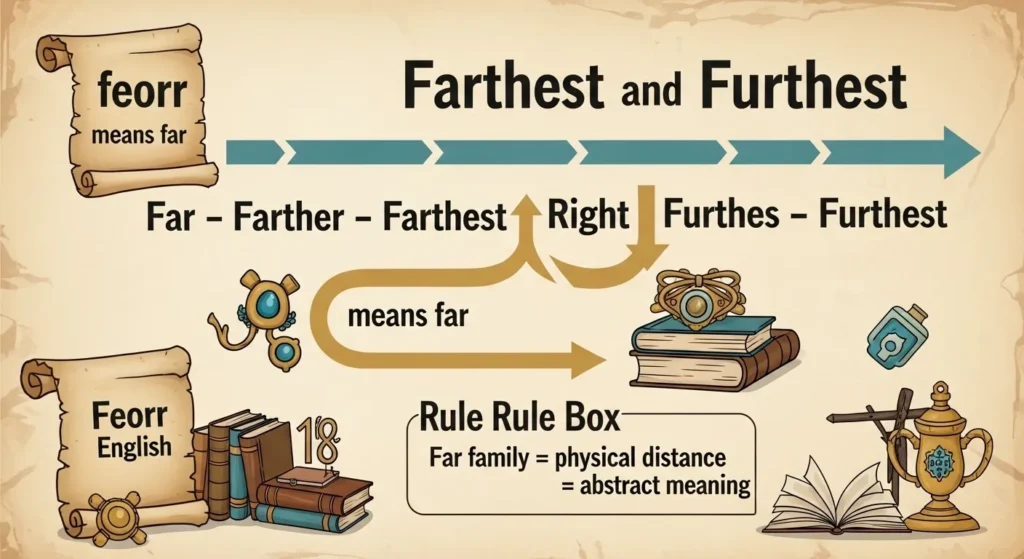
Both words come from the Old English word “feorr”, which means far. Over time, English added endings to show degree, like farther, farthest, further, and furthest.
- Farthest grew from far
- Furthest grew from further
Originally, English speakers used these words very freely. There were no strict rules. Writers used both forms for distance and ideas.
Later, modern grammar guides tried to separate their meanings to reduce confusion:
- Far family → physical distance
- Further family → abstract or figurative distance
That is why today we follow a use-based rule, not a spelling rule.
British English vs American English Spelling
Both farthest and furthest are correct in British and American English. The difference is preference, not correctness.
Key Differences
- American English prefers farthest for physical distance.
- British English uses furthest more often, even for physical distance.
Comparison Table
| Context | American English | British English |
| Physical distance | farthest | furthest |
| Abstract distance | furthest | furthest |
| Formal writing | farthest (distance) | furthest |
| Everyday speech | farthest | furthest |
👉 Both forms are correct, but usage style changes by region.
Which Spelling Should You Use?
Choose based on your audience 👇
For US Audience
Use farthest for physical distance.
Use furthest for abstract meaning.
For UK & Commonwealth Audience
You can safely use furthest in most cases.
For Global or SEO Content
Use:
- Farthest → when distance is physical
- Furthest → when meaning is abstract
This approach sounds natural to everyone and avoids confusion.
Common Mistakes with Farthest or Furthest
Here are errors people often make 👇
❌ Using farthest for ideas or limits
Wrong: This is the farthest I can go mentally.
Correct: This is the furthest I can go mentally.
❌ Thinking one spelling is “wrong”
Both words are correct. Context matters.
❌ Mixing regional rules
Don’t force British style in American exams.
❌ Avoiding both words
Some people avoid them due to fear. Don’t. Use the rule.
Read More.Yogurt or Yoghurt: Which Spelling Is Correct and When to Use It?
Farthest or Furthest in Everyday Examples
Emails
- “The farthest office is in New York.”
- “We will take this issue furthest next week.”
News
- “The village is the farthest from the capital.”
- “The investigation went furthest under this government.”
Social Media
- “Who traveled the farthest this year?”
- “This challenge pushed me the furthest.”
Formal Writing
- “The farthest measurable distance was recorded.”
- “The theory was taken furthest by modern researchers.”
Farthest or Furthest – Google Trends & Usage Data
Search data shows:
- Farthest is more popular in the United States
- Furthest is searched more in the UK, Canada, and Australia
Usage Pattern
- Travel, maps, sports → farthest
- Goals, limits, progress → furthest
Both keywords are strong for SEO, but user intent decides which one fits better.
Comparison Table: Farthest vs Furthest
| Feature | Farthest | Furthest |
| Physical distance | ✅ Yes | ✅ Yes |
| Abstract meaning | ❌ No | ✅ Yes |
| US preference | High | Medium |
| UK preference | Medium | High |
| SEO safe | Yes | Yes |
FAQs: Farthest or Furthest
1. Are farthest and furthest interchangeable?
Sometimes yes, but not always. Use farthest for physical distance.
2. Which is more correct?
Both are correct. Context decides.
3. Is furthest British English?
It’s used more in British English, but not limited to it.
4. Can I use furthest for distance?
Yes, especially in British English.
5. Which should I use in exams?
Follow your region’s English style guide.
6. Which is better for SEO?
Use the one that matches user intent and context.
7. Is one more formal?
No. Both are formal and informal friendly.
Conclusion
The difference between farthest or furthest is simple once you understand the idea behind them. Farthest is best for real, physical distance things you can measure, see, or count.
Furthest goes beyond distance and works for ideas, limits, progress, and abstract meaning.
Both spellings are correct in British and American English. The choice depends on context, audience, and style, not on strict grammar rules.
That’s why people get confused and why this keyword is searched so often.
If you write for a global audience, follow the meaning-based rule. It sounds natural, professional, and clear. If you write for exams or regional readers, match their English style.
Once you remember distance vs idea, you’ll never pause again while choosing between farthest or furthest.

Mark Nichol is an English language writer and editor.
He focuses on spelling confusion, word comparisons, and clear usage rules.