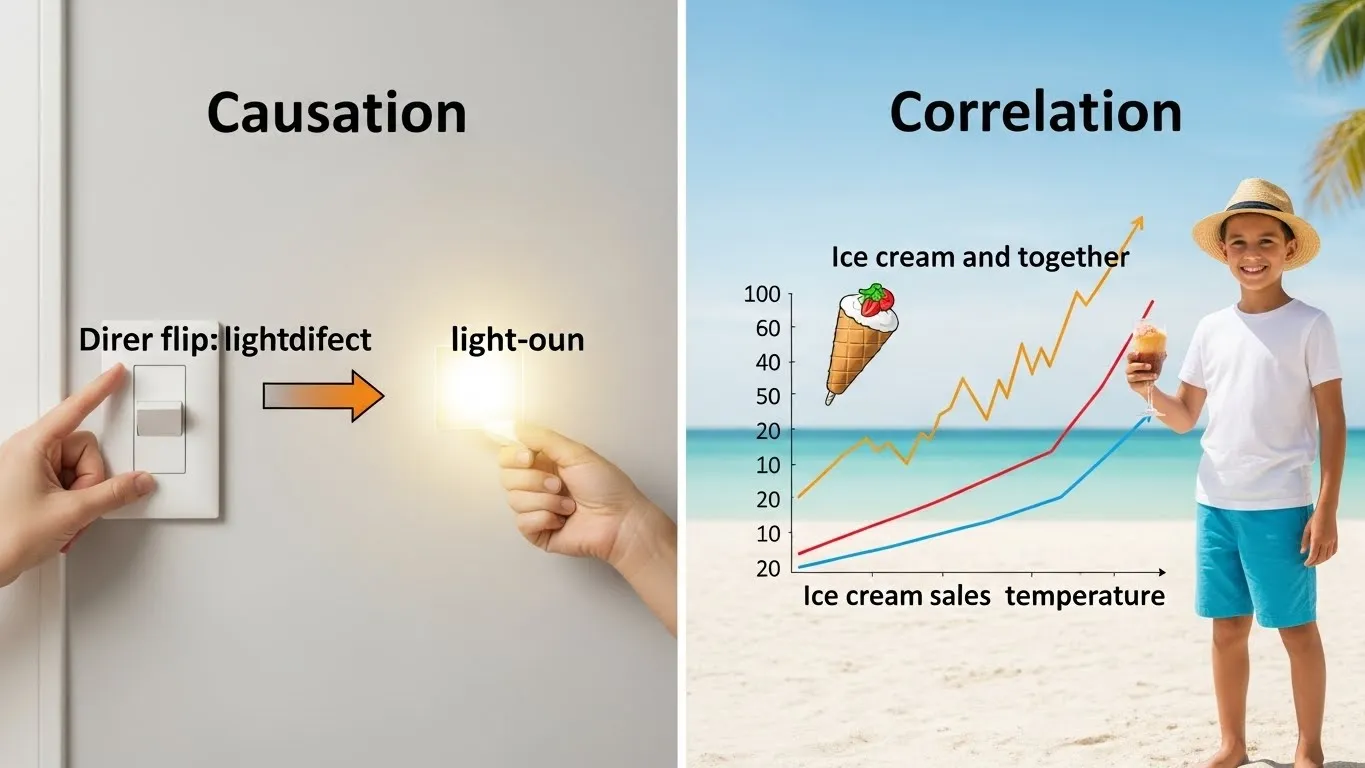
“Causation or correlation” is one of the most searched phrases in research, data analysis, journalism, and everyday debates.
People often see two things happen together and assume one causes the other. This confusion leads to wrong conclusions, poor decisions, and misleading headlines.
For example, if ice cream sales and drowning incidents both rise in summer, does ice cream cause drowning? Of course not but many people fall into this trap.
Users search for causation or correlation because the difference is not always obvious. Both concepts deal with relationships between events, numbers, or behaviors, but they mean very different things.
Students want clarity for exams, professionals need accuracy for reports, and readers want to spot false claims in news and social media.
This article solves that confusion clearly and simply. You’ll get a quick answer, real-life examples, common mistakes to avoid, and guidance on correct usage.
By the end, you’ll know how to tell causation from correlation and why that difference is critical in science, business, and daily life.
Causation or Correlation – Quick Answer
Correlation means two things move together.
Causation means one thing directly causes the other.
Example:
- Correlation: People who carry umbrellas often get wet.
- Causation: Rain causes people to get wet.
Correlation does not prove causation. Two things can be linked without one causing the other.
The Origin of Causation or Correlation
The word causation comes from the Latin causa, meaning “reason” or “cause.” It entered English in the 14th century through philosophy and science.
The word correlation comes from the Latin correlatio, meaning “relation” or “connection.” It became common in statistics in the 19th century.
There are no spelling variations between regions. Unlike words such as “colour” and “color,” both causation and correlation are spelled the same everywhere because they are technical, Latin-based terms.
British English vs American English Spelling
There is no spelling difference between British and American English.
| Term | British English | American English |
| Causation | Causation | Causation |
| Correlation | Correlation | Correlation |
These words are standardized in academic and professional writing worldwide.
Which Spelling Should You Use?
You don’t need to choose a spelling style.
- US audience: Use causation and correlation
- UK/Commonwealth audience: Use causation and correlation
- Global audience: Same spelling works everywhere
Focus on correct meaning, not spelling.
Read Also.In or Within: What’s the Difference and When Should You Use Each?
Common Mistakes with Causation or Correlation
- Assuming correlation equals causation
❌ More screen time causes poor grades
✅ Screen time is correlated with poor grades - Ignoring third variables
❌ Coffee causes stress
✅ Stress and coffee may both be linked to workload - Using causation in headlines without proof
❌ Social media causes depression
✅ Social media use is linked to depression
Causation or Correlation in Everyday Examples
- Emails:
“There is a correlation between delays and traffic volume.” - News:
“The study found no causation between diet soda and cancer.” - Social Media:
“Just because it trends doesn’t mean it causes change.” - Formal Writing:
“Correlation was observed, but causation was not established.”
Causation or Correlation – Google Trends & Usage Data
Search interest in causation or correlation is highest in:
- United States
- United Kingdom
- Canada
- Australia
- India
The phrase is most used in:
- Education
- Statistics
- Health reporting
- Business analytics
It spikes during exam seasons and when viral studies appear in the news.
Comparison Table: Causation vs Correlation
| Feature | Causation | Correlation |
| Meaning | One causes the other | Things move together |
| Proof needed | High | Low |
| Common in | Experiments | Observational studies |
| Risk of error | Lower | Higher |
FAQs
1. Does correlation ever mean causation?
Sometimes, but only with strong evidence and testing.
2. Can causation exist without correlation?
Rarely, but weak data can hide real causation.
3. Why do people confuse them?
Because patterns look convincing without deeper analysis.
4. Which is stronger, causation or correlation?
Causation is much stronger.
5. Is correlation useless?
No. It helps find patterns worth studying.
6. Are both used in science?
Yes, but causation needs controlled studies.
7. Can media misuse these terms?
Yes, very often.
Conclusion
Understanding causation or correlation is essential in a world full of data, claims, and quick conclusions. Correlation only shows that two things are linked.
Causation proves that one thing directly creates change in another. Mixing them up can lead to false beliefs, bad decisions, and misleading information.
There is no spelling difference between British and American English, so your focus should always be on correct usage and clear meaning.
In professional writing, reports, and news, it’s safer to say “correlation” unless causation is proven. In everyday life, this knowledge helps you question headlines, social media claims, and even personal assumptions.
If you remember just one rule, let it be this: correlation is a clue, not a conclusion. Use these terms carefully, and your communication will instantly become more accurate, credible, and professional.

Mark Nichol is an English language writer and editor.
He focuses on spelling confusion, word comparisons, and clear usage rules.