Have you ever paused while writing and wondered: Is it “preceed” or “precede”? You’re not alone. This is a very common spelling confusion, especially in professional writing, emails, legal documents, and academic work.
Both words look correct at first glance, and because English has many similar-looking verbs, mistakes happen easily.
People usually search for “preceed or precede” because they want a fast, clear answer—and they want to avoid embarrassment. A single spelling error can reduce credibility, especially in formal or SEO-focused content.
The confusion mainly comes from pronunciation and from other English words that end in -ceed, -cede, or -ceed.
This article solves that confusion once and for all. You’ll get a quick answer, a simple explanation, real-world examples, and guidance on which spelling to use depending on your audience. By the end, you’ll never hesitate again when choosing between preceed and precede.
Preceed or Precede – Quick Answer
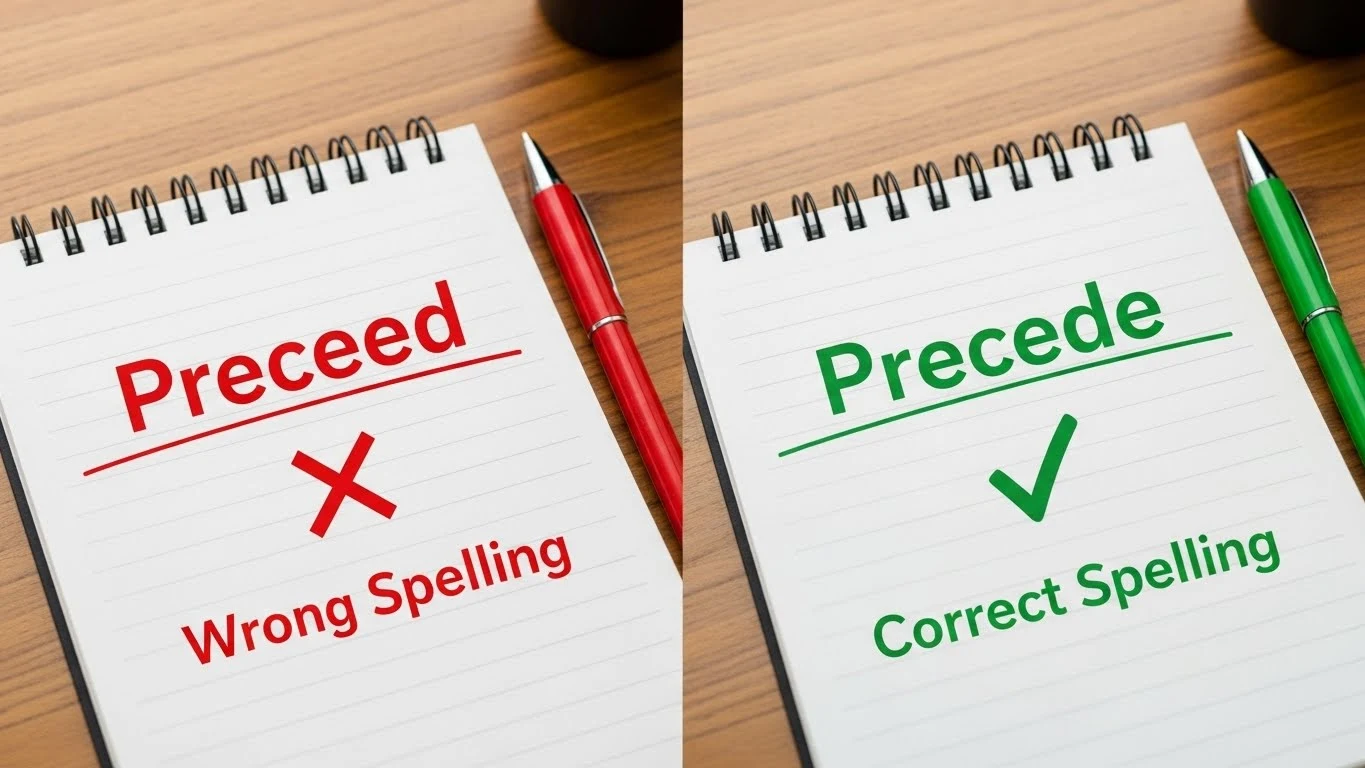
✅ The correct spelling is precede.
❌ Preceed is incorrect and not a real English word.
Example:
- The introduction will precede the main article.
- A warning message usually precedes the error.
If you see preceed anywhere, it’s a spelling mistake.
The Origin of Preceed or Precede
The correct word precede comes from the Latin word praecedere, meaning “to go before.”
It combines:
- prae = before
- cedere = to go
English kept this structure, which is why precede follows the -cede pattern.
The confusion happens because English also has words like:
- succeed
- exceed
- proceed
These use -ceed, but precede does not. English spelling isn’t always logical, and history plays a big role in these differences.
British English vs American English Spelling
There is no difference between British and American English for this word.
Both use:
- precede ✅
- preceed ❌ (wrong everywhere)
Spelling Comparison Table
| Version | Correct Spelling | Example |
| British English | precede | A title should precede the text |
| American English | precede | Events precede consequences |
| Incorrect Form | preceed | ❌ Not accepted |
Which Spelling Should You Use?
Use precede in all situations:
- US audience: precede
- UK/Commonwealth audience: precede
- Global or SEO content: precede
There is no regional variation, so you never need to switch spelling.
Common Mistakes with Preceed or Precede
Here are the most frequent errors:
- ❌ The meeting will preceed lunch.
✅ The meeting will precede lunch. - ❌ Events preceed outcomes.
✅ Events precede outcomes. - ❌ Adding extra “e” because of pronunciation
✅ Remember: pre + cede
Tip: If you remember precedent, you’ll remember precede.
Preceed or Precede in Everyday Examples
Emails
- Please read the instructions that precede this email.
News
- Negotiations preceded the agreement.
Social Media
- Teasers often precede major announcements.
Formal Writing
- The abstract must precede the research paper.
Preceed or Precede – Google Trends & Usage Data
Search data shows that “preceed or precede” is typed frequently worldwide.
Most searches come from:
- Students
- Content writers
- Legal and academic professionals
The incorrect spelling preceed appears often in searches, but precede dominates actual published content, confirming it as the only accepted form.
Read more.Bravo or Brava? Which One Is Correct and When to Use It
Preceed vs Precede – Comparison Table
| Word | Correct | Meaning | Usage |
| precede | ✅ Yes | To come before | Formal & informal |
| preceed | ❌ No | None | Spelling error |
FAQs preceed vs precede
1. Is “preceed” ever correct?
No. Preceed is always incorrect.
2. Why do people spell precede wrong?
Because of similar words like proceed and exceed.
3. How do I remember the correct spelling?
Think of precedent—both share the same root.
4. Is precede used in legal writing?
Yes, very commonly.
5. Does precede change spelling in British English?
No. It’s the same everywhere.
6. What is the noun form of precede?
The noun is precedence.
7. Is precede formal or informal?
It works in both styles.
Conclusion
The confusion between preceed or precede is common, but the rule is simple. Precede is the only correct spelling, no matter where or how you use it. The mistake happens because English has inconsistent spelling patterns and similar-looking verbs.
Once you understand the word’s Latin origin and connect it with related words like precedent and precedence, the confusion disappears.
For writers, students, and professionals, using the correct spelling improves clarity and credibility. There is no British vs American difference, no alternative version, and no exception. If something comes before another thing, it precedes it always spelled with -cede.

Pam Peters is an Australian linguist known for her work on English spelling and usage differences.
She specializes in British and American English variations.